You don’t need thousands of dollars to start investing. Many brokerages have no minimums and let you buy fractional shares, so $25 or $50 is enough to begin.
Step 1: Get the order right
- Small emergency fund ($1,000).
- Employer 401(k) match, if you have one.
- Pay off credit card debt.
- Open a Roth or traditional IRA.
- Invest more in your 401(k) or a regular brokerage account.
Step 2: Pick a simple investment
For most beginners, one of these is enough:
- A target-date fund with the year you plan to retire. One fund, automatically diversified, gets more conservative over time.
- A broad index fund such as a total stock market or S&P 500 fund, possibly paired with a bond fund.
Look for low fees. The “expense ratio” should usually be well under 0.2%.
Step 3: Automate it
Set an automatic transfer and investment every payday. Consistency beats timing.
What to avoid as a beginner
- Hot stock tips and “the next big coin”
- Trading apps that push you to trade often
- Paying high fees for products you don’t understand
- Checking your balance every day and panic-selling
How much can small amounts grow?
At a 7% average return (not guaranteed), $100 a month becomes about $52,000 in 20 years and about $262,000 in 40. $500 a month becomes about $260,000 in 20 years and about $1.3 million in 40. Small and steady is how most people build wealth.
Go deeper
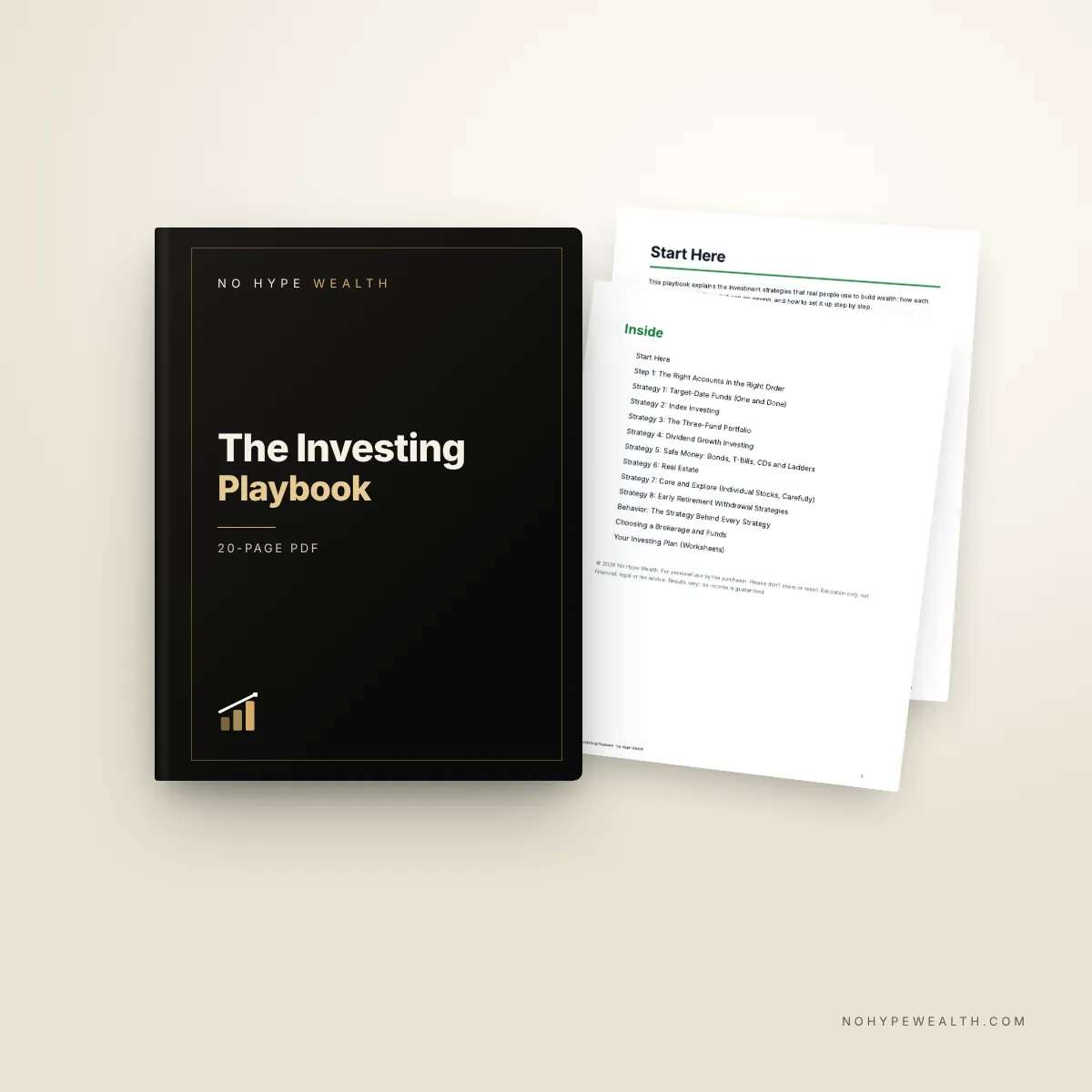
The Investing Playbook
8 proven investment strategies explained in plain English, with example portfolios and your own investment policy worksheet. Education only, no stock tips.
See what’s inside · $27